In Africa, career progression no longer follows a single path. Across the continent, professionals are navigating an expanding set of choices, from building ventures to pursuing structured learning.
At the same time, the talent pool is growing rapidly. By 2050, one in four workers globally will be African, according to projections from the African Development Bank. Opportunity is expanding, but so is competition. Standing out is no longer about access alone, but about how you think, respond to change, and turn insight into action.
With more options comes more noise. What separates those who move forward with clarity from those who stall is not the path they choose, but the learning habits they build along the way.
At ALUSB, these learning habits are already visible in how professionals develop, navigate complexity, and create impact. Here are five we see consistently.
Don’t Be a Luddite
Every era produces its own version of resistance to change. The Luddites pushed back against industrial machinery. Today, the resistance is quieter, but no less consequential. It appears in hesitation, in the instinct to wait until tools are fully understood before engaging with them, and in the belief that certain shifts can be ignored.
Across Africa’s fastest-moving sectors, the professionals who advance are rarely those who have mastered every tool from the outset. They are those who are willing to learn on the move, to test unfamiliar systems, and to remain open to the idea that the way work is done today may not hold true tomorrow.
Artificial intelligence is one expression of this broader shift, but the principle extends far beyond it. The real advantage lies in adaptability and in meeting new tools with curiosity rather than resistance.
Learn It, Then Use It
Theory still matters, but its value becomes clear when it is applied. The professionals who move forward are those who take what they learn and test it in real situations, allowing their thinking to evolve through their learning habits rather than remain abstract.
At ALUSB, this approach is built into the design of every programme. Whether in the Executive MBA or executive education offerings, professionals engage with strategy, leadership, and emerging technologies while continuing to work in real environments, so what they learn is shaped by what they are actually doing.
The result is a more practical way of building capability, where knowledge is not simply accumulated, but applied, refined, and built on over time.
Think Bigger Than Your Job Title
Work is becoming less defined by roles and more defined by problems. The most important challenges rarely sit within a single function, and the ability to see beyond a job title is what allows professionals to contribute meaningfully across them.
Across industries, decisions are rarely confined to a single discipline. Strategy depends on people, technology depends on context, and growth depends on the ability to bring these elements together and act on them with sound judgment.
At ALUSB, this interdisciplinary approach is built into the design of programmes. In offerings such as Strategic Management and Leadership, professionals develop across multiple areas at once, from personal leadership and team communication to strategic planning and organizational thinking, reflecting how decisions are made in real environments.
Over time, this expands how professionals approach their work, not as a set of separate functions, but as connected systems they can navigate and influence with confidence.
No Man is an Island
Even at the highest levels, very little is built alone. The companies that define industries were shaped through collaboration, through people working in close proximity, challenging each other’s thinking, and building something stronger together than they could have individually. It is hard to imagine Facebook without its early collaborators, or Apple without the partnership between Jobs and Wozniak, because those outcomes were never the result of one perspective alone.
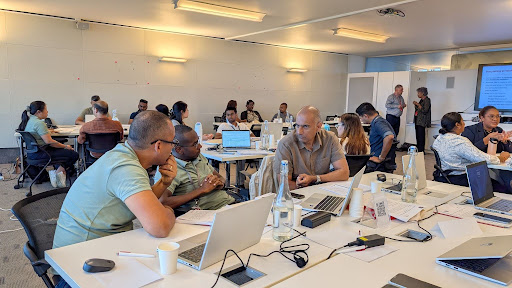
That same dynamic carries into how professionals grow. At ALUSB, learning happens alongside others who are operating in different industries and markets, which means ideas are constantly tested against real experience rather than left unchallenged. You are not only refining your own thinking, but seeing how others approach similar problems from entirely different angles.
What emerges from that kind of environment is a different kind of momentum, where ideas move faster, decisions are sharper, and the work itself becomes more ambitious because it is built with others, not alone.
Get Your Hands Dirty
One habit we consistently see in strong ALUSB professionals is a willingness to stay close to the work. They are not afraid to get involved, to test ideas in real conditions, and to understand problems at the level where they actually exist.
This instinct is visible across the ALU ecosystem.
Drifter Innovations is one such example. Founded by ALU alumni Mahui Brian and Ian Christian and based in Kigali, the venture reflects what it means to build with proximity. In many African cities, something as simple as getting a cold drink can depend on where you are, whether you are stuck in bumper-to-bumper traffic, and how you are able to pay. Their smart vending machines were designed around these realities, integrating mobile money from the outset and refining each version through use in real conditions.
What they have built works because it is grounded in how people actually move, transact, and access goods, not in how those systems are assumed to operate.
There is no single path that guarantees progress. What makes the difference is how you move through the choices before you, how you learn, how you adapt, and how you respond when the context shifts.
Across ALU, the philosophy has always been grounded in this idea. Learning is not separate from the real world. It is shaped by it, tested within it, and strengthened through experience. The learning habits that emerge from that approach are not theoretical. They are built through doing, through working with others, and through staying close to the environments where change is happening.
At ALUSB, that same approach is carried into the Executive MBA, where learning is not a pause from work, but an extension of it, designed to sharpen how you think, decide, and lead as the demands around you evolve.
If you are thinking about your next move, it is worth choosing a path that allows you to keep building while you learn. REGISTER YOUR INTEREST